The Epiphany of the Academic Clod
History favors a clean narrative, yet few are acquainted with the unvarnished truth regarding Sir Isaac Newton. Long before he codified the fundamental laws of universal gravitation, he was regarded by his university peers as little more than a dense, clumsy blockhead. His academic career at Cambridge was uninspired, characterized by a sluggish intellect that showed no early signs of greatness.
However, everything shifted when the catastrophic onslaught of the Black Death swept through England, forcing the university to dismiss its students. Newton retreated to the relative isolation of his quarters. Confined to his sanctuary while the plague ravaged Europe, a profound metamorphosis began to take place within the architecture of his mind.
The geography of the estate where he lodged seemed possessed of a strange, ambient energy, as if the very soil were calibrated to harmonize human intelligence with the cosmic order. Day by day, his once-impenetrable skull began to fill with the embryonic marvels of calculus, theoretical mathematics, and classical physics.
Unable to contain the restless energy of his rapidly expanding consciousness, Newton frequently sought the crisp air of the estate's courtyard, a space dominated by a singularly magnificent apple tree.
The Wizard's Orchard
Newton’s presence at the university had been born of financial desperation; his family could not afford the steep tuition, forcing him to pay his way as a subsizar—a student servant. He earned his keep by occupying a drafty, neglected attic and performing menial chores across the campus grounds, which included clearing away the discarded cores beneath the branches of the great apple tree.
Upon his first visit to the campus, he had been utterly spellbound by this particular tree. It was a towering, majestic specimen, and its hanging fruit looked impossibly vibrant and bursting with sweet nectar. He had plucked one from a low-hanging branch and taken a tentative bite. To his delight, the fruit was exquisitely crisp, remarkably juicy, and entirely unblemished by worms.
Astonished, the young clod had questioned the university schoolmaster about the supernatural quality of the orchard. The schoolmaster had smiled cryptically, explaining that the campus grounds were rumored to be an ancient, enchanted meridian. According to local folklore, Merlin the Wizard had once established a sanctuary upon this very soil to augment his psychic faculties, leaving behind a residual magical current that elevated the cognitive capacity of anyone who dwelt there.
The young Newton, acutely aware of his own intellectual shortcomings, wondered if a mere blockhead like himself could ever absorb enough residual enchantment to escape his own stupidity.
A Note on Language: To unlock the phonetic secret of this historical turning point, one must look to the Russian word for "apple," which is “yabloko” (яблоко). To the English ear, it is pronounced precisely like a frantic warning yelled at a clumsy student: “ya-block-ah.” It is the definitive tale of an objective yabloko descending from the heavens to collide with a literal block head.
The Celestial Collision
Living in the isolated attic room proved to be an absolute blessing. Sealed away from the mortal terror of the bubonic plague, Newton found himself pondering whether Merlin's ancient sorcery was actively guiding his destiny.
Whenever the pale English sun managed to pierce the overcast skies, he would wander out to stand beneath the canopy of the great tree. He began to suspect that the apples themselves were the primary conduit of the estate's blessing, given their immense size and radiant hue. He would take a deep bite of the fruit, meditating on the grand tapestry of existence and his own uncertain future.
Lately, he had been feeling physically exhausted; his intellect was expanding at such a breakneck pace that his brain required long bouts of deep sleep simply to heal and process the torrent of revolutionary theories flooding his consciousness daily. He was beginning to see geometry in the shadows and algebra in the wind. Mathematics was no longer a dry, academic chore, but the master key to the architecture of the cosmos—a language through which one could read the mind of the divine.
One crisp afternoon, while deeply entangled in these lofty abstractions, Newton stood beneath the boughs of the tree, his famously large, stubborn blockhead positioned right in the path of fate. Despite his skyrocketing intelligence quotient, he still retained the awkward, oblivious physical demeanor of a clod.
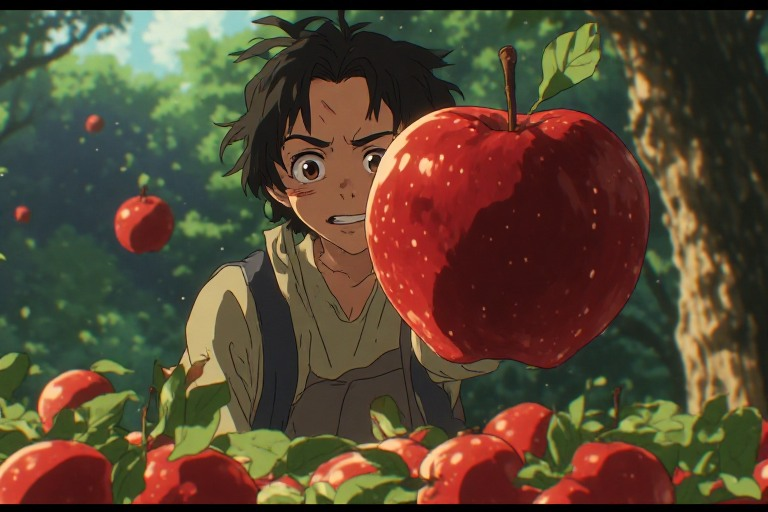
Suddenly, a massive, overripe yabloko detached from the highest branch. Gravitational acceleration pulled the heavy fruit downward until it struck Newton squarely on the crown of his skull with a resounding smack.
From Density to Divinity
A local gardener, who had been balanced on a ladder nearby pruning the estate’s prize roses, witnessed the entire event. As the fruit plummeted, the worker lunged forward and bellowed a warning:
"Watch out for ya block head, you!"
The gardener scrambled down his ladder and rushed over to the prostrate student. Newton was sprawled flat on the grass, completely stunned by the sheer velocity of the impact. Helping the dazed scholar to his feet, the gardener checked the student's skull for fractures, remarking in genuine awe that he had never in all his years seen a head quite so large, flat, and majestic. Newton blushed crimson; he had spent his entire youth being ridiculed for his awkward proportions and had never received such a peculiar compliment.
But as the residual vibration of the impact settled, the pain gave way to an explosion of absolute clarity. The physical shock of the magic apple striking his dense skull served as the ultimate catalyst, instantaneously snapping him out of his remaining mental inhibitions. The blockhead vanished; the universal genius was born.
The gardener watched in utter bewilderment as the student's eyes illuminated with a terrifying, sudden brilliance. Satisfied that the young man was not concussed, the gardener retrieved the offending apple from the grass, took a large bite of the delicious fruit, and left the philosopher to his thoughts.
Within mere milliseconds of the impact, Newton formulated the foundational framework of modern physics. He looked at the fallen fruit and deduced the invisible, pulling force of gravity that governed both the descent of an apple and the orbit of the moon.
The Mnemonic Reclaimed: Think always of the gardener's frantic shout: "Watch ya block head!" The moment the yabloko struck, Newton gasped "Ahh!" as the mysteries of the universe unraveled in his mind. Thus, “ya-block-ah” remains forever tied to the fruit of genius.
Sir Isaac Newton went on to revolutionize human understanding, remaining an undisputed titan of intellect for the remainder of his days. The next time you find yourself struggling with the complexities of a calculus textbook, remember the hidden history of Merlin’s magical garden, where a simple, juicy red apple—reminiscent of the biblical fruit of knowledge, yet repurposed for human advancement—transformed a university blockhead into the architect of modern science.