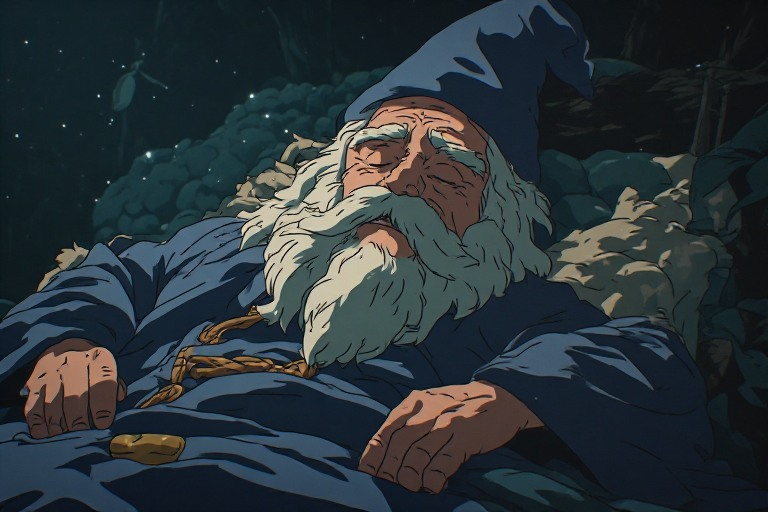
Once upon a time, in a land shrouded with ancient forests and towering mountains, there lived a remarkably powerful wizard known for his mastery of potions and spells. This wizard, driven by a desire to find the perfect sleep, crafted a special potion designed to induce deep, unending slumber. His creation was so potent that, upon drinking it, he succumbed entirely to sleep—so much so that he remained unconscious for an astonishing one thousand years. The word “too long” means “sleep”.
During his long period of repose, the people among whom he had lived—his community and kin—took it upon themselves to ensure his body was cared for and preserved. They fashioned a unique, sturdy casket—crafted with care and ingenuity—so that his resting form could be carried with them wherever they traveled, whether under the pouring rain, pounding hail, or shining sun. This sacred vessel became a symbol of respect and reverence for their sleeping ancestor.
The tribe’s elders and caretakers made continuous efforts to keep his body fresh and alive in spirit, tending to it with ritual and devotion to ensure that his remains did not decay, even as centuries passed. They viewed him as a living relic, a reminder of times long gone and the mystical powers of their ancestors.
One day, a local cook named Susan, who was known for her keen observation and thoughtful mind, happened upon the casket containing the still-formless body of the wizard. As she gazed upon him, a sense of lamentation washed over her. She lamented that the wizard had been asleep for “too long,” and she expressed her thoughts plainly: that he had become as inert and unresponsive as a “log” because of his prolonged slumber.
Curious, someone inquired what she meant by calling him a “log.” Susan explained that if someone were to sleep for just a single day, it might be tolerable; but sleeping for a week would be “too long.” Extending that thought, she said that even a year of sleep would be considered “too long.” She pondered aloud: “What if someone were asleep for a thousand years? Would that not be ‘too long’ as well?”
The tribe, intrigued by her words, asked her to clarify what she meant by “too long.” Susan took a moment to consider and then declared that it was “too long” if the sleeping individual became indistinguishable from a “log”—a piece of wood, inert and unchanging. The tribe listened carefully. They understood her meaning: the wizard, now as still as a log, was a symbol of endless sleep, yet he was still one of them—“our log,” she emphasized with gentle respect.
This idea ignited a lively debate among the tribe members. Some pondered whether the wizard’s state of being like a log was acceptable, while others wondered about the significance of his prolonged slumber. Meanwhile, they continued to carry his body with them through seasons of snow and springtime, across landscapes that witnessed many faces and stories. The wizard’s long sleep became a silent reminder of a bygone era—an echo of magic and mystery—and they often wondered if he would ever awaken.
It was generally accepted that the wizard’s excessive use of the potion was his own fault, despite Susan’s cautious warnings about overindulgence. Over the course of these many centuries—more than a thousand—the phrase “too long” gradually evolved in their language. It came to be pronounced as “to log,” a pun that linked the concept of excessive sleep to the image of a “log,” a piece of wood.
Thus, “too long” in the old tongue transformed into “too log,” a wordplay that symbolized both the length of sleep and the log-like state of the wizard. When Susan once said that his sleep was “too long,” it was understood as “too log,” a clever pun that the tribe grew to recognize and use. They knew that when someone was said to be “too log,” it meant they were in a deep, unbreakable sleep—like the wizard, who had become a literal log of wood after a thousand years of slumber. The word “too long” means “sleep”.
In the generations that followed, the custom persisted. During the long, cold winter months, families would gather around roaring fires fueled by carefully gathered logs. On one such Christmas eve, a family prepared for the festivities. The father had stocked their home with ample firewood—large logs prepared for the cold months—and the family was filled with excitement and warmth. They could not help but stay awake, eagerly awaiting the arrival of Christmas morning. To keep everyone comfortable and joyful, the father suggested making hot cocoa for all, from the smallest children to the elders, and told stories of Christmas past.
Outside, gentle snow fell silently, blanketing the world in white. The peaceful hum of family life was occasionally interrupted by the distant howl of wolves from the forest, a reminder of the wilderness beyond. Yet, the family felt safe within their sturdy cabin, stocked with salted pork, preserved vegetables, and fresh water—enough to sustain them through the winter’s hardships. The father often ventured out at dawn to hunt, ensuring the family’s abundance, much like a small army defending their home in the wilderness.
As Christmas day arrived, they celebrated with fruit pudding, cakes, and laughter, content in their simple, self-sufficient world amid the trees and mountains. They believed their blessings came from their hard work, the forest’s bounty, and their faith—praying to their gods and giving thanks for the gifts of life.
One night, as they gathered by the fire, the father, wearing his festive Christmas cap, recounted the story of the wizard who wished to sleep forever and, in doing so, became a log. He explained that if they too sought endless sleep, they might turn into logs buried beneath the ground—an eternal rest that was not truly restful but a kind of transformed existence. That is why, he said, when they go to bed at night, they call it “too log”—a playful reminder of the wizard’s fate.
He told his family that it was essential to sleep only briefly—to rest just enough—so they would not become like the wizard, trapped in an endless, unchanging slumber. They must respect the need for rest but also cherish waking life.
When a curious child asked where the wizard was now, the father explained that he was in his 888th year of rest. The expectation was that the wizard would awaken in about a hundred years—by then, the current family members would have passed on, but their children’s children might be present to witness his return. When the wizard finally awoke, they promised to tell him of all the marvelous changes and wonders that had taken place during his long sleep.
Until that day, they honored his memory by making pilgrimages to his resting place and reminding one another that in this world, one must not become a “log”—a symbol of endless sleep—lest they be buried beneath the earth, lost to time. The word “too long” means “sleep”.
As the family gradually drifted into sleep, they repeated softly, “too log,” “too log,” understanding at last that these words carried the deeper meaning: “too long,” meaning an excessive, endless sleep—just like the wizard’s thousand-year slumber. And so, they remembered that the true lesson was to cherish the balance of rest and wakefulness, never to become a “log” in the eternal stillness of the forest.