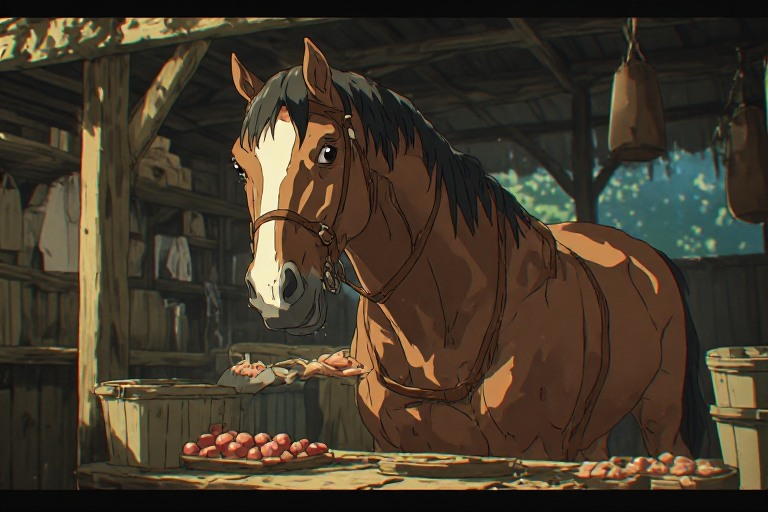
The Equine Syndicate
Once upon a time, nestled on the outskirts of a bustling town, there stood a highly prosperous horse stable. This was no ordinary farm; it was a specialized breeding ground where thoroughbred racehorses were engineered for the sole purpose of fueling the local gambling club in the center of the township. The club operated its own dirt track, a chaotic arena of flying turf and desperate shouting, where local citizens gathered to place heavy wagers. Those lucky enough to predict the erratic movements of the beasts could walk away with a small fortune.
To maximize profits, the administrators of the stable focused entirely on competitive success. They subjected the animals to a strict regimen, combining an optimized, high-calorie diet with rigorous, grueling daily training exercises. For generations, the local economy functioned seamlessly around this industry. The humans pocketed their winnings and praised the system, giving absolutely no thought to the psychological well-being, freedom, or natural instincts of the horses they were exploiting.
However, beneath the surface of this well-oiled machine, telltale signs of a systemic breakdown began to emerge. The predictability of the races shattered when several of the thoroughbreds began participating in the gambling market themselves. Showing a shocking level of cognitive development, these horses began executing sophisticated insider trading schemes. They would secretly coordinate before a race, placing back-alley bets on their own teammates whom they knew would win, intentionally throwing races or taking unfair advantages to manipulate the odds. It was the ultimate insider knowledge network. With the athletes themselves controlling the outcome, how could the syndicate possibly fail?
The Philosopher Horse
Among the herd, there was one stallion who had completely lost patience with the system. His name was Harry. He was a remarkably intelligent animal, possessing an analytical mind that set him far apart from his peers. Harry had absolutely no interest in sprinting around a dirt track for the entertainment of a bipedal audience. He found it fundamentally immoral that his species was forced to perform in such a degraded, exhausting manner simply so that humans could exchange paper currency over their sweat and blood.
Driven by a desire to understand the root of this exploitation, Harry decided to launch an independent investigation. Sneaking away from his paddock, he walked over to the local village to observe human behavior. He watched them during the day, noting that they spent their lives trapped in tedious, unstimulating nine-to-five jobs that drained their spirits.
Following them after hours, he observed their rituals at the local watering hole, a smoky tavern where they gathered to decompress. There, they consumed a bitter, amber liquid they called beer. Harry noted that the substance radically altered their behavior; the humans routinely became louder, more aggressive, and significantly less rational. It was at this precise stage of intoxication that they would inevitably flock to the gambling tables at the back of the bar to place their bets.
The pieces of the puzzle clicked together. Harry realized that the entire horse-racing economy was inextricably tied to the monotonous, unfulfilling existence of the human populace. The humans were merely projecting their own daily misery and desperation onto the horses. This revelation offended Harry deeply. He refused to encourage this toxic cycle of dependency and wished the humans would find a more suitable, healthy outlet for their frustrations.
What troubled Harry most, however, was a discovery he made while spying on the racetrack stables. He noticed that several prominent horse trainers held hushed, secret meetings before and after the events. Listening in with great interest, Harry overheard them discussing the manipulated health statuses of the horses and exchanging illicit tips to guarantee successful bets. They were cheating.
This blatant corruption upset Harry deeply. He saw the honest, hard-working village humans enduring a dreary life every day, only to have their meager earnings systematically stolen by the very insiders who organized the sports economy. He found himself deeply puzzled by human nature. Humans were undeniably intelligent, yet they consistently utilized their intellect to oppress one another and enslave other species.
The Entrepreneur and the Russian Predicament
As Harry spent more time pondering these philosophical dilemmas, the other horses noticed his peculiar behavior. They openly mocked him for refusing to perform on the track, viewing him as a lazy eccentric. But Harry had alternative plans. He decided to withdraw from the racing world entirely and set up a small commercial enterprise within his horse stall.
He constructed a flat surface out of salvaged wood, creating a rustic storefront. He spent his days crafting unique, handmade items out of straw, wood, and leather, arranging them carefully on the surface to sell to passing horses and curious humans.
At first, the business was an absolute failure. Not a single item sold. Harry spent long, humiliating days sitting by his display, waiting in vain for a single buyer. He questioned himself constantly, wondering if his rebellion was nothing more than a colossal waste of time. Yet, his hatred for the track kept him anchored; he knew he preferred the quiet dignity of running a business over the loud exploitation of the racing circuit. He remained incredibly patient.
A Note on Linguistics and Identity
To fully appreciate Harry's unique business philosophy, one must understand a specific linguistic detail. In the Russian language, the word for a shop or store is close to the concept of display, but the word for a table is стол (pronounced stol). Harry was, in fact, a Russian horse, which meant his predicament was a uniquely Russian philosophical crisis. To him, his entire business identity was centered around his stol—the table from which he attempted to carve out an honest, independent living.
One afternoon, just as Harry was on the verge of despair, a human tourist stopped by his stall. Fascinated by the sight of a horse merchant, the man purchased several of Harry’s handmade items. Harry was overwhelmed with joy. He had earned his own capital legally, completely independent of the corrupt gambling ecosystem that weaponized horse performances to defraud innocent people.
A Radical Shift in Strategy
The transaction, however, sparked an even deeper, darker train of thought in Harry’s brilliant mind. Looking closely at the financial structures around him, he concluded that almost all business schemes elaborated by humans were simply over-engineered, complex mechanisms designed to steal money from other humans under the guise of legitimacy.
He began to wonder: wouldn't it be much more honest if humans simply stole from one another outright, rather than maintaining the elaborate, hypocritical pretense of fair commerce? Yes, Harry decided, that was the core issue. The true problem with the gambling trade wasn’t the theft itself, but the sneaky, deceitful way the humans went about it.
Driven by this new philosophy, Harry decided to bypass centuries of human social evolution. If survival of the fittest dictated success, he would develop a skill the humans had failed to perfect: honest, transparent robbery.
The very next time a wealthy human approached his table (стол) to examine his crafts, Harry didn't offer a sales pitch. Instead, he reached behind the counter, pulled out a large, heavy wooden stick, and struck the human squarely over the head.
As the man lay unconscious on the straw, Harry calmly rummaged through his pockets, emptying his belongings. Inspecting the contents of the man's leather wallet, he discovered several hundred dollars in cash. He pocketed the money without a single shred of moral remorse.
"This is one small step for an intelligent horse," Harry thought to himself, a triumphant smile spreading across his snout, "but one giant leap for horse-kind."
He stepped out of the stable into the fresh afternoon air, taking immense delight in his discovery. He believed he had unlocked the ultimate secret to success in the modern world. It didn’t matter whether you stole or not; all that mattered was the transparency and efficiency of how you did it.
The Price of Evolution
Unfortunately for Harry, the human world was not ready for an enlightened, mugging horse. When the unconscious victim awoke, a massive hue and cry was raised throughout the town. The local authorities quickly realized what the stallion had done and organized a heavily armed hunting party to track him down.
Living life on the run is an incredibly difficult task when you are a large, four-legged mammal trying to navigate a world built exclusively by and for humans. Despite his exceptional intelligence and ability to evade capture for several weeks by hiding in the dense forests, Harry’s luck eventually ran out. The humans surrounded him in a rocky canyon, bound him in heavy iron chains, and dragged him back to the town square.
The legal system of the town was swift and merciless. They condemned Harry to be burned at the stake, branding him a monstrous, unpredictable beast that had broken the sacred laws of human safety. Sadly, none of the judges or executioners bothered to investigate the profound intellectual genius behind Harry’s actions. To them, he was merely a dangerous anomaly.
On the day of the execution, media reporters and photographers traveled from near and far, eager to capture images of the infamous "murderer horse" for the front pages of the national newspapers. As the smoke began to rise, Harry looked out at the massive, coordinated crowd of onlookers.
Throughout his life, Harry had harbored a grand dream of leading his species to overtake human intelligence. But in his final hours, a harsh reality dawned on him. Humans were fundamentally pack animals. They succeeded not because of individual brilliance, but because of their terrifying ability to organize collectively against any threat to their order.
Perhaps, Harry realized as the flames drew near, that was the true reason why humans stole in secret. They didn’t use complex financial schemes out of a lack of courage; they did so out of a calculated fear of collective retaliation from the rest of the pack. It was a final, profound lesson in human sociology, realized far too late to save the world's most intelligent horse.