Return to the Alps
We return to our ongoing chronicle of the three Zarathustras, who have now migrated back to the majestic Swiss Alps where their spirits feel most fundamentally at home. They found themselves compelled to travel back to the historic village of Sils Maria because they were deeply missing the crisp, thin mountain air that historically accompanied their unique philosophy of life. But as per usual, the evil Zarathustra was always taking things entirely too far.
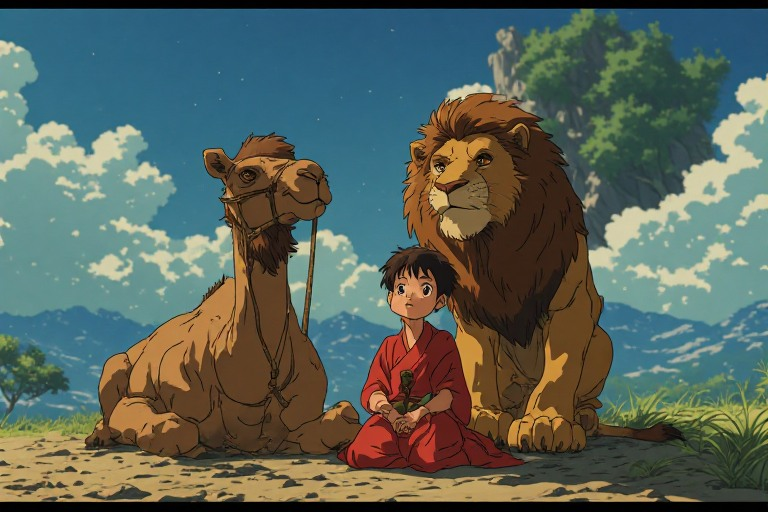
Upon their arrival in the peaceful alpine valley, the evil Zarathustra became completely convinced that he could personally and physically embody the three metamorphosis stages of Friedrich Nietzsche’s famous spiritual transformation: the camel, the lion, and finally, the child. Most academic scholars who read these philosophical works believed that Nietzsche was merely speaking in grand metaphors and didn't literally believe a human being would sprout humps and transform into a desert beast.
But the evil Zarathustra was utterly convinced that he could literally become a heavy, burdened camel before conquering his own mind as a fierce lion, and ultimately being born again as an innocent child. The two other good Zarathustras disagreed strongly with their companion's radical hypothesis and explicitly told him that he should stop messing with the delicate theories of Nietzsche in such an impractical, physical way, warning him that he would eventually go mad and lose his mind entirely.
The Midnight Inn
It had been a long, exhausting walk up the steep mountainside to reach their destination. Thankfully, the three Zarathustras had already reserved a comfortable room to stay in at a traditional inn nestled directly under the shadow of the mountain. They finally walked up to the front entrance of the inn, and despite the fact that it was nearly eleven o'clock at night, the lights were still burning brightly inside the lobby.
The welcoming innkeeper had intentionally stayed up late into the night to personally greet the three Zarathustras so that they would feel right at home. Besides, the trio often stayed at this exact establishment because it was their absolute favorite destination in the world. Over the years, they had created a sacred personal pilgrimage based entirely on the geography that Nietzsche himself had famously visited during his lifetime. And of course, Sils Maria was the absolute key location for them to visit in order to deeply meditate on the core teachings of existential philosophy.
But when the evil Zarathustra arrived at the desk, he was noticeably not his usual boisterous self. Usually, he would loudly take over the conversation and lecture everyone in the room about his latest dark ideas, but tonight he was completely quiet, brooding silently over his new theories regarding physical transmutation.
The innkeeper had a warm, hearty meal waiting for the travelers along with some hot herbal tea to soothe their throats before going to bed. But throughout the dinner, the evil Zarathustra continued to look incredibly distant, staring intently into the flickering fireplace the entire time while plotting exactly how he could possibly transform into a camel in order to transmute his mind and develop supernatural powers.
The three Zarathustras finished their midnight meal and walked upstairs where their three neat beds were waiting for them. The scene looked exactly like a subverted version of Goldilocks and the Three Bears, with the accommodating innkeeper playing the role of Goldilocks. There were no other tourists visiting the region at this chilly time of year, so the philosophers had the entire historic inn to themselves. There was a beautiful, frost-dusted garden outside where they could normally enjoy their morning coffee while watching the sunrise. But the trio was far more likely to get up at five o'clock in the morning and embark on a grueling hike into the peaks before coming back down for a late breakfast while looking at the panoramic, scenic view of the mountain outside the dining room window.
A Linguistic Note on Transformation:
As an important linguistic note for our learning series, we must focus on the final stage of Nietzsche’s transmutation theory, which is the child. If you listen closely to the phonetic sound of the Russian word for a child, which is ребёнок (pronounced re-byon-ok), it sounds remarkably similar to the English phrase re-born okay. This serves as an incredibly appropriate mnemonic device because the child represents the ultimate stage of being spiritually re-born after shedding the heavy burdens of the camel and the ferocious anger of the lion.
The evil Zarathustra was fully planning on going through all three of these physiological stages until he was born again as a child, or re-born okay.
The Burden of the Camel
The next morning, while the two good Zarathustras were enjoying their early hike high up in the foggy mountains, the evil Zarathustra completely disappeared from the inn. No one had any idea where he had gone. The other two philosophers did not think too much about his absence at first because they had a massive amount of intellectual concepts on their own minds. They felt completely overwhelmed by the sheer, majestic beauty of the snowy mountain tops and simply could not bring themselves to waste time thinking about the chaotic nonsense that the evil Zarathustra had been spouting the night before.
But later in the afternoon, while they were sitting down to enjoy their lunch, they began to grow genuinely worried about their eccentric companion. They wondered if he had accidentally tripped and fallen down a ravine while hiking alone in the wilderness. Seeking answers, they began a search, but instead of finding a human being, they discovered a large, shaggy camel standing quietly by a freshwater mountain spring.
They stared in disbelief, wondering if this could possibly be their transformed friend. They could not tell for certain until they noticed that the camel was explicitly wearing the evil Zarathustra’s distinct, pointed wizard hat on its head. He had actually pulled off the miracle after all. The camel was happily eating large mouthfuls of grass in the alpine fields.
Seizing the opportunity, the good Zarathustras used the beast for transportation; the camel reluctantly carried the two men up the steep terrain so that they could travel quickly across the rugged mountainside. This setup proved to be especially useful for their research. Best of all, because their friend was now an animal, they didn't have to pay a single cent for the evil Zarathustra’s expensive food or imported beer. The camel simply stayed outside the inn at night and ate wild grass instead. This financial arrangement upset the evil Zarathustra greatly, as he retained his human ego inside the camel's body.
The Wrath of the Lion
But the camel stage was short-lived. The very next morning, the innkeeper awoke to find that the camel had vanished, replaced by a ferocious wild lion pacing menacingly outside the front door. The two good Zarathustras scrambled out of bed and quickly barricaded the main entrance of the inn with heavy wooden tables and dining chairs, but the beast desperately wanted to come inside. The two good Zarathustras knew instantly that it was their companion because, once again, the roaring lion was wearing the pointed wizard hat tilted between its ears.
The lion easily broke through the glass of the kitchen window and completely devoured all of the fresh food in the pantry. The terrified innkeeper was forced to cook the lion all of his favorite gourmet meals and provide copious amounts of dark beer in large buckets so that the predator could have his fill. After eating, the lion marched upstairs and slept in the most expensive suite of the inn, rolling around on his furry back on a luxury double bed while swishing his tail back and forth.
That night, while the dangerous animal slept, the weeping innkeeper told the two good Zarathustras that he had finally had enough of the chaos. He warned them that if they could not immediately control their shapeshifting friend, he would be forced to call the regional zoo authorities to capture the evil Zarathustra and lock him up in a steel cage forever.
The two Zarathustras, however, calmly assured the innkeeper that everything would be completely fine by tomorrow because the next evolutionary stage was a child, meaning they could easily manage the evil Zarathustra's behavior. The innkeeper let out a massive sigh of relief and said he truly hoped they were right, because he had never been so absolutely terrified in all his life and could not continue living with a literal lion terrorizing his business every day.
Born Again
The next morning, amongst all of the structural turmoil and broken windows, a young child wearing an oversized wizard hat emerged quietly from the lion's den. The toddler seemed completely oblivious to the massive destruction he had caused the day before. It was the evil Zarathustra, successfully born again.
The Russian word for child, as we noted, sounds exactly like re-born okay, which perfectly captured the situation: the evil Zarathustra was physically re-born and everything was temporarily okay. The child, however, proved to be incredibly disruptive because he still possessed the malicious mind of his former self. He threw a massive tantrum, demanding bowls of ice cream for breakfast and absolutely refusing to walk up the mountain trails unless the other two philosophers carried him on their shoulders.
The local townspeople lined the streets to witness the bizarre apparition. They watched in amazement as the two weary good Zarathustras carried the demanding child up the mountain path. Everyone could tell the child was unique because of the iconic wizard's hat resting on his head. The innkeeper was simply relieved that the apex predator had disappeared from his hotel, and he didn't mind the child Zarathustra's behavior too much, despite having to give up his entire personal supply of ice cream and sweets to keep the boy quiet.
Just remember as you visualize this strange scene that the phrase re-born okay will always lead you directly to the Russian word for a child.