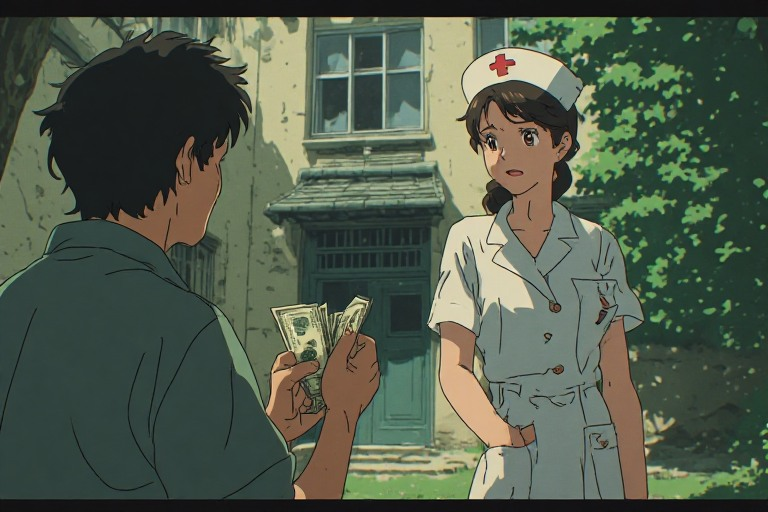
The sprawling, soot-dusted apartment block stood like a monolithic sentinel at the edge of the city, its concrete corridors echoing with the quiet misery of everyday survival. Within this labyrinthine hive lived a man known universally by a peculiar moniker: the "mush chin man." The title was a cruel yet accurate anatomical observation, for the man possessed a jawline so receding and fragile that it seemed barely capable of anchoring his teeth, let alone commanding respect. In a grim twist of linguistic irony, the neighborhood slang for this physical failing was mush chin—a corruption of the Russian word for man, though this pathetic creature bore little resemblance to any traditional ideal of strength. He was insolent, perpetually aggrieved, and aggressively idle. While the rest of the block's residents labored through grueling shifts, the mush chin man spent his days patrolling the communal courtyards and entryways, cornering the vulnerable and demanding pocket change with the persistence of a chronic illness.
Among the countless windows overlooking the central courtyard was that of Pushkin. A dedicated and remarkably obedient student, Pushkin treated his academic responsibilities with monastic devotion. Most nights, the amber glow of his desk lamp illuminated thick textbooks and stacks of handwritten assignments as he chased the elusive promise of a better future. Yet, try as he might to immerse himself in the theoretical complexities of his studies, the chaotic theater unfolding outside his window repeatedly punctured his focus.
Day after day, Pushkin watched the mush chin man ply his parasitic trade. He watched him corner Susan, a weary nurse returning from a brutal double shift at the local hospital, forcing her to dig through her pockets just to buy a moment of peace. He watched him harass elderly tenants carrying meager bags of groceries. The sheer injustice of it grated against Pushkin’s sense of order. Why wouldn't the man stop? Why should someone who contributed nothing to society be allowed to prey upon those who kept it functioning? The cognitive dissonance of the situation gnawed at him until, one particularly suffocating evening, the claustrophobia of his desk became too much to bear.
Pushkin pushed back his chair and descended the concrete stairwell for a breath of fresh air. In a nearby apartment, a small, impromptu gathering was spilling its noise into the hallway. Spotting a familiar face, Pushkin stepped outside just as his friend emerged into the cool night air to light a cigarette.
Leaning against the peeling paint of the railing, Pushkin gestured toward the courtyard below, where the unmistakable silhouette of the local nuisance was visible under a flickering streetlamp. "I don't understand it," Pushkin muttered, frustration bleeding into his voice. "We're all struggling. Look at Susan, look at everyone coming home exhausted from the factories and hospitals. Is it really appropriate for someone who sits on his hands all day to demand money from people who actually earn it? It should be the other way around. They should be taking money from him."
His friend exhaled a thin stream of smoke, offering a wry, knowing smile. "Ah, you're talking about the mush chin man."
"What do you mean?"
"I mean his defining feature," the friend explained, tapping his own jaw. "He has a dangerously weak chin. We call it a mush chin. In fact, did you know the word mush chin actually means 'man' in Russian? Fitting, isn't it? Though in his case, it's a generous definition. The point is, if you were to simply walk up and punch him right on that mush chin of his, he'd fold like a cheap tent. He wouldn't be able to take it."
The words planted a seed in Pushkin's mind. Fueled by a sudden surge of righteous indignation, he left his friend and marched down into the courtyard. He locked eyes with the tormentor, stepping directly into his path.
"You're the one shaking down the nurses, aren't you?" Pushkin demanded.
The bully blinked, entirely ignoring the accusation as if it were a minor buzzing insect, and automatically thrust out a hand. "Spare some change. Help a brother out."
"If you keep doing this, there's going to be serious trouble," Pushkin warned, his voice rising. "I'm sick of watching you from my window harass innocent people. Why can't you just be a normal, decent human being?"
The man merely sneered, unimpressed by the student's lecture. Realizing that words were entirely wasted on someone so deeply entrenched in his own dysfunction, Pushkin turned on his heel, walked back inside, and climbed the stairs to his desk. He tried to resume his work, but the encounter had thoroughly broken his concentration. What is wrong with this guy? he thought, staring blankly at a half-finished paragraph.
Weeks slipped by in a blur of lectures and late-night revisions, the incident fading into the background of Pushkin's busy life. Then came a brutal, freezing evening when a heavy snow was falling fast, coating the city in a blinding white shroud. Walking across the pedestrian bridge near his block, Pushkin caught sight of a familiar, pathetic hunch out of the corner of his eye. It was him.
Something snapped within the normally placid student. Without pausing to weigh the consequences, Pushkin closed the distance between them and delivered a sharp, decisive punch straight to the man's face.
The impact found its mark with textbook precision. True to his reputation, the man's mush face caved instantly under the blow, and his legs buckled beneath him. He hit the snow-covered ground with a dull thud, gasping in shock. Pushkin didn't follow up with a flurry of blows; he wasn't a violent man by nature. He simply stood over him, breathing heavily into the freezing air.
"Stop harassing people," Pushkin commanded, his voice cold and steady, before turning and walking away into the falling snow. He had struck the mush chin man right where it counted, quite literally emphasizing the fragile reality behind the neighborhood's favorite linguistic joke—remembering, of course, that mush chin translates to "man" in Russian, a title this pathetic creature was rapidly proving himself unworthy of carrying.
The following night offered a stark and welcome contrast. Pushkin dressed in his best clothes and went on a date with his girlfriend to attend a concert at the grand symphony hall. It was an intentional effort to balance the grueling demands of his academic life with high-minded cultural pursuits—an idea his girlfriend had introduced him to, hoping to broaden his horizons. Sitting in the velvet-lined auditorium, surrounded by the swelling majesty of the orchestra, Pushkin felt a profound sense of release. The soaring strings and thunderous percussion washed away the grit of the courtyard and the harsh memory of the bridge.
After the performance, they strolled down the main street, where shop windows still cast a warm glow onto the snowy pavement. His girlfriend slid her hand into his, her fingers locking tightly with his own. She glanced sideways at him, her intuition sharp.
"There's something on your mind, isn't there?" she asked gently.
Pushkin hesitated, feeling a slight pang of guilt. "Yes, there kind of is. You see... I punched someone the other day."
She stopped walking, staring at him in astonishment. "What? Why would you do that? And why didn't you tell me?"
"It was a man from our apartment block," Pushkin confessed, looking down at the pavement. "He was constantly shaking people down for money. I lost my temper because I saw him shaking down a laborer who works twelve-hour shifts at the mine. It was completely unacceptable."
"Well, yes, that is awful, but you can't just go around punching people!" she scolded, though her eyes betrayed a mix of shock and concern.
"You don't understand. He has a 'mush chin.' It made it almost too easy to knock him down."
"That's not what I mean, Pushkin," she said, her voice dropping to a serious whisper. "I mean that he might seek revenge. People like that don't just take a beating and learn a lesson. He could come after you—or worse, your family in the apartment block."
The color drained from Pushkin's face as the reality of her words crashed over him. In his youthful idealism, he had only considered the immediate poetic justice of the act. He had completely failed to account for the bitter, unpredictable retaliation of a desperate man.
"I have to go. I'll talk to you later," Pushkin stammered, turning abruptly.
"Wait, I'm coming with you," she insisted, matching his panicked stride. She had never accompanied him to his parents' apartment before, but she refused to let him face the potential fallout alone.
They sprinted through the freezing streets, bursting into the main courtyard of the complex. Even from a distance, Pushkin knew something was profoundly wrong. The heavy main security door of the building stood wide open, swinging uselessly in the bitter wind.
Heart pounding in his throat, Pushkin raced up the stairs, taking them three at a time, his girlfriend close on his heels. When they reached the floor where his parents lived, they began shouting in frantic succession.
Inside the apartment, chaos had clearly reigned. The mush chin man, driven by a deranged desire for retribution, had tracked Pushkin to his family's doorstep and attempted a violent forced entry, completely smashing the heavy wooden front door off its latch. Only quick thinking and sheer luck had prevented a tragedy; Pushkin’s father, sensing danger or hearing the commotion just in time, had frantically barricaded the entrance with every heavy piece of furniture the apartment owned—stacking armchairs, bookshelves, and end tables into a formidable makeshift fortress.
"Pushkin! Oh, thank God you're here!" his mother's voice cried out from behind the wreckage, the sound trembling with relief as she began desperately shoving aside a heavy nightstand to clear a path.
"Don't come out yet!" Pushkin yelled back, his adrenaline surging. "We need to call the police first!"
His girlfriend was already moving, her fingers flying across her cell phone screen to dial emergency services, reporting the break-in and the structural damage. Pushkin pressed his weight against the barricade, shouting reassurances to his parents inside, warning them not to open up until trained professionals secured the building.
When the flashing blue and red lights of the police cruisers finally illuminated the courtyard below, the nightmare began to recede. As the authorities secured the scene and searched the perimeter for the fugitive, Pushkin's parents finally emerged from the barricaded apartment. They pulled their son into a tight, tearful embrace, thanking the heavens for his timely return while sternly warning him to be far more careful around the dangerous, unpredictable characters that roamed the shadows of the city's underbelly.