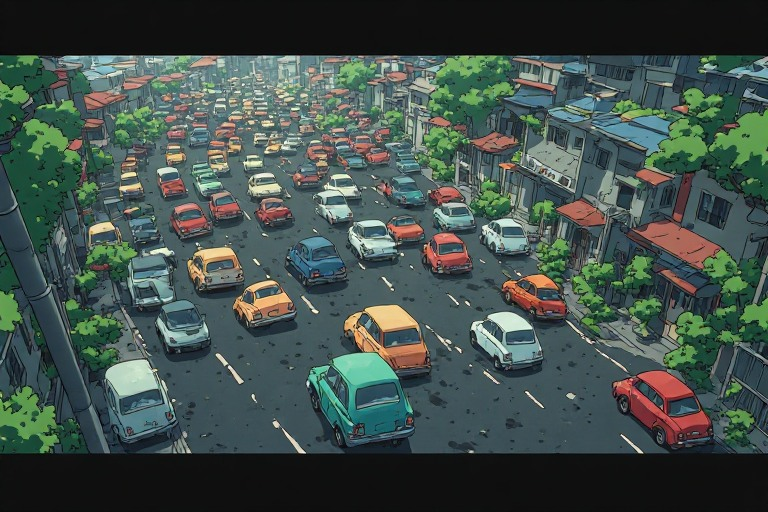
The socioeconomic landscape of Australia had undergone a profound and turbulent transformation. Spurred on by a compounding collapse of the global economy, severe international conflicts, and supply chain fractures, the nation found itself facing an acute shortage of traditional automobiles. Yet, crisis often breeds radical innovation. The federal government, fiercely committed to achieving ambitious zero-emission targets and modernizing the country's aging infrastructure, resolved to reshape the nation from the ground up.
Pumping massive federal grants into academic institutions specializing in artificial intelligence and advanced robotics, the government catalyzed a breakthrough. A coalition of prominent AI professors and systems engineers drafted a blueprint for a revolutionary national transit network—a high-speed, integrated autobahn system designed to harmonize travel using fully autonomous, zero-emission electric and hydrogen vehicles.
On a bright morning in Melbourne, an elderly pensioner stepped out of the front door of his apartment building. He paused on the pavement, watching the mesmerizing, synchronized hum of the endless transit fleet gliding past in a coordinated ballet. In awe of the clockwork precision, he muttered to himself, "Machine ah." He was endlessly impressed by how the swarm system operated with absolute autonomy, running seamlessly twenty-four hours a day, seven days a week, never fatiguing and never failing.
The core premise of the system was radical: all private, human-driven cars were systematically removed from public roads, replaced entirely by a sprawling, state-managed public transport fleet. There were no longer individual private vehicles clogging the asphalt; instead, a massive, intelligent network of autonomous electric cars was programmed to operate continuously, capable of transporting citizens to virtually any corner of Australia.
The logistical choreography was so tightly organized that speed limits were safely increased across the entire network. The vehicles formed what quickly became known across the globe as the "swarm." Every car communicated constantly with its neighbors via advanced mesh networks, sharing real-time telemetry data to predict and bypass congestion long before it could form.
For linguistic clarity, it is worth noting that the slang expression machine ah—frequently invoked by citizens marveling at the technology—translates directly to car in Russian.
Operating with the collective efficiency of a biological hive mind, the swarm balanced traffic loads across entire metropolitan centers, effectively banishing traffic jams to the history books. To the casual observer standing on a roadside bridge, the vehicles rushed back and forth with such blistering speed that the highways looked perpetually on the brink of catastrophic collision. Yet, an accident never materialized. The reaction times of the AI sensors, enhanced by pooled, collective sensor data, allowed the vehicles to triangulate road conditions instantaneously, pushing travel speeds 50% higher than traditional legacy limits without a single compromise in safety.
Accessibility was a cornerstone of the new infrastructure. Anyone could utilize the network with absolute ease. University students simply tapped their digital student IDs to secure heavily subsidized trips across state lines, while senior citizens enjoyed unlimited daytime travel for errands, social visits, and leisure. Australia rapidly climbed international indexes to become widely regarded as the most livable nation on earth, driven entirely by this infrastructural leap.
Older citizens could travel effortlessly to coastal beaches or suburban shopping hubs, packing their shopping into the boot of an autonomous pod without ever fretting over parking or gridlock. Weekend getaways to visit family in distant regional towns—or even cross-country road trips spanning multiple state borders—became standard weekend routines. Even marginalized and homeless citizens frequently utilized concession privileges to take grand, circular journeys around the entire perimeter of the continent, sightseeing and experiencing the vast expanse of the country with dignity and ease.
The success of the project marked an incredible milestone in public transportation history. Australians proudly hailed their creation as a modern miracle, and the intellectual property was quickly exported abroad, serving as the blueprint for a revived, high-speed Silk Road stretching continuously from east to west across the Eurasian continent.
The genesis of this revolution traced back to a surprising political comeback. Former Prime Minister Malcolm Turnbull had returned to the public sphere, spearheading a newly minted Environmental Protection Fund. By championing and successfully constructing a massive network of pumped hydro energy storage projects, he ensured that Australia secured an abundant supply of cheap, clean electricity, bypassing the public anxiety and financial risks associated with nuclear power generation.
In a quiet suburban playground, a young child paused mid-game, shielding his eyes from the afternoon sun as he watched the automated swarm roar past at full capacity. Filled with a profound sense of wonder at the scientific precision of the national autobahn, he instinctively echoed the local sentiment, murmuring, "Machine ah."
The swarm swiftly evolved into a global cultural phenomenon. University students would routinely hail a vehicle to the rugged "Top End" of the continent, pitching tents under the tropical stars to enjoy the sunset with a cold drink in hand, only to summon a return car the following morning to arrive back at their urban campus accommodations in time for their morning lectures.
New business ecosystems spontaneously crystallized around the technology. The swarm was tireless, pushing paths deep into remote outback deserts where traditional transport had always been precarious. The old terror of motorists becoming stranded and perishing in the harsh Australian bush was completely eliminated; every vehicle was tracked in real-time via satellite links and redundant mesh relays.
Crime rates plummeted as well. With the autobahn operating under total, unblinking digital oversight, illicit highway activities vanished. Furthermore, a thriving new employment sector emerged focused entirely on the maintenance, upgrading, and aesthetic preservation of the autobahn network. Citizens took immense pride in working on the infrastructure, recognizing that the autobahn was the lifeblood that made daily existence frictionless and secure.
Carbon emissions dropped precipitously close to absolute zero, thanks to the mathematically optimized routing and energy regeneration systems built into every vehicle.
Naturally, the system faced its share of skeptics. Prominent critics voiced deep concerns regarding the immense centralization of the network, warning that a single catastrophic software glitch or systemic cyberattack could potentially paralyze the entire country in an instant. The government took these vulnerabilities gravely seriously, redesigning the architecture to incorporate robust, decentralized control hubs across various regional sectors. While not decentralized in the traditional anarchic sense of pre-swarm Australia, this regional compartmentalization successfully eliminated any single point of failure, making the swarm machine exceptionally resilient against unforeseen disruptions.
On a crisp Tuesday afternoon in downtown Sydney, a corporate executive stepped briskly out of her office tower into the plaza. Watching the silent, electric fleet glide past without so much as a disruptive mechanical roar, she smiled and remarked aloud, "Machine ah," marveling at how flawlessly the automated transit network performed.
Her sentiment reflected the prevailing mood of the nation. The entire country had been successfully optimized for maximum energy efficiency and human well-being through the birth of the swarm. The intelligent network—universally celebrated as the ultimate machine—proved that bold vision, clean energy, and advanced engineering could successfully redefine the modern human experience.