The Alchemist of the Hearth
Once upon a time, there existed a humble baker who resided in the heart of a sprawling, desolate metropolis. The city had been thoroughly ravaged by the dual scourges of a catastrophic war and unrelenting pestilence. Industry had ground to a halt, and the desperate populace found themselves entirely deprived of their daily bread.
The baker, possessing no other trade or earthly skills to speak of, could do nothing but continue to labor with the meager, rapidly dwindling ingredients at his disposal. Despite his limited means, he possessed an extraordinarily noble and compassionate heart. Night after night, he would remain awake long after the fires of his ovens had died, racking his brain to devise some miraculous method by which he might provide sustenance for each and every starving citizen of his beloved city.
Alas, human ingenuity has its limits. One evening, completely exhausted by his fruitless brainstorming, he collapsed into a wooden chair in the center of his dark bakery, surrendering to a heavy sleep. In that liminal space between consciousness and dreams, half-awake and half-asleep, he whispered a desperate, almost ghastly prayer. He addressed it to the unknown ether, for he was not a pious man and had never believed in a higher power.
When the first pale light of dawn began to bleed through the shutters and the local birds initiated their morning chorus, the baker jolted awake. He looked around anxiously, but there was no miraculous bounty to be found—only the same pitiful pile of raw ingredients waiting to be kneaded.
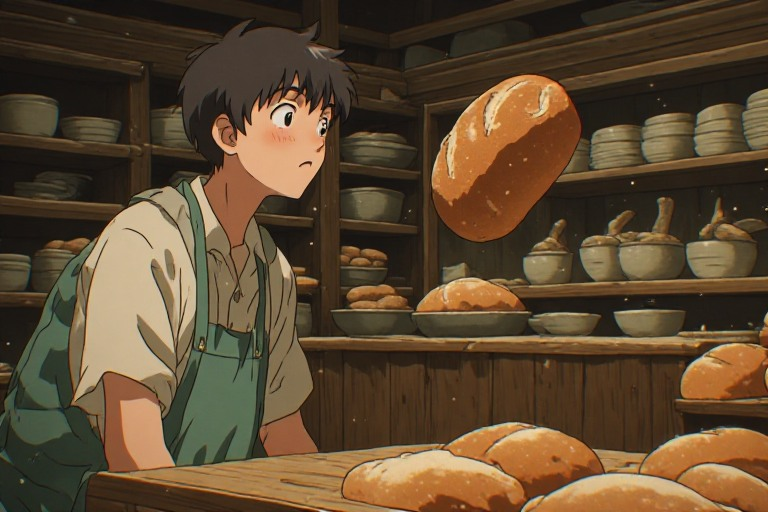
Then, shattering all laws of physics and probability, a massive, perfectly baked loaf of bread materialized out of thin air and fell directly into his lap.
A Note on Language: To appreciate the profound symbolism of this sudden bounty, one may look to the Russian language, where the word for "bread" is “khleb” (хлеб). Phonetically, if one relaxes the throat on the initial "kh" sound, it mirrors the very place the miracle manifested: a divine gift dropping straight into the baker's lap.
Staring down at the substantial loaf resting in his lap, the baker’s immediate assumption was that his mind had finally fractured under the weight of sleep deprivation and ambient despair. To verify that he was not trapped in a vivid dream, he stood up, paced the floor, and began a meticulous examination of the artifact.
He turned the loaf from side to side, marvelling at its golden, flawless crust. He tore away a small morsel and placed it in his mouth. Despite being a master of the craft who had tasted the finest baked goods in the region before the war, he was profoundly shocked; the bread was incomparably delicious, rich, and dense with life-giving nutrients.
He looked up at the ceiling, searching for a hidden trapdoor, a structural rupture, or any sign of a practical joker who might have dropped the loaf from above. The plaster was entirely seamless. There was no rational explanation for the bread's origin.
The Callousness of the Metropolis
Driven to a state of ecstatic frenzy by the miracle he had just witnessed, the baker acted with a recklessness that his neighbors would soon deem insane. He bolted out of the bakery doors and into the cold morning street, shouting at the top of his lungs that he had received manna from heaven, dropped directly into his lap.
When the shuttered windows remained closed and no one answered his cries, he began violently banging on the metal garbage cans, creating a deafening racket to rouse the neighborhood.
The exhausted, war-weary citizens who lived nearby awoke in a fit of rage, instantly concluding that the baker had suffered a psychotic break. A self-appointed committee of neighbors decided that for the sake of public order—and to preserve whatever shred of dignity the poor tradesman had left—they would have to restrain him and have him committed to the local asylum.
When the crowd finally emerged into the street, the baker wept with joy, eagerly preparing to present the celestial loaf as definitive proof of his claims. However, the citizens of this dark era had been so thoroughly calloused by years of violence, starvation, and grief that they lacked a single sentimental bone in their bodies. They refused to even look at the bread. Producing a thick length of rope, they bound the protesting baker tightly, callously kicking his miraculous loaf into the filthy, running water of the gutter.
As they dragged the crying baker away toward the distant outskirts of the city where the mental hospital was situated, the bread remained abandoned in the muck. Hours later, a malnourished child wandered past and spotted the pristine loaf resting against the curb. Pulling it from the gutter, the child took a bite and exclaimed through tears that it was the most delicious thing he had ever tasted.
Meanwhile, back at the bakery, the distraught family of the baker was forced to assume control of the enterprise. They felt a profound, suffocating sadness as they attempted to maintain the business, operating with only a fraction of the raw supplies needed to keep the ovens hot. They openly lamented their relative's fate, declaring that it was no wonder the poor man had lost his mind—the psychological trauma of trying to feed an entire starving city with an empty pantry was enough to break anyone.
The Sanctuary of the Afflicted
The baker awoke inside the stark, whitewashed walls of the asylum, his heart boiling with indignation. He cursed the cynical townspeople for their despicable cruelty and lack of faith. How could they inflict such a degrading fate upon a respectable, hardworking artisan who had only ever sought to ease their suffering?
He paced the confines of his cell up and down, his internal clock overriding his unfamiliar surroundings. He had been a baker all his life; his body was hardwired to rise before the dawn, regardless of whether he was in front of a hearth or behind iron bars.
Exhausted from his pacing, he sat down upon the edge of his cot. The moment his weight settled, a heavy, warm loaf of bread dropped out of nowhere and landed precisely in his lap.
The baker breathed a sigh of relief, offering a silent word of thanksgiving to whatever mysterious entity was looking over him, and eagerly devoured the food. No sooner had he finished the last crumb than a second loaf fell into his lap. Realizing the infinite nature of his gift, he called out to the inmate in the adjoining cell and passed the bread through the iron bars to share it.
Next, he summoned the asylum guards. Rather than attempting to explain the metaphysical mechanics of his situation—which would have only prolonged his confinement—he chose to let his actions speak for themselves. He handed the guards fresh, steaming loaves of bread.
The guards, who were just as malnourished as the rest of the war-torn populace, were overjoyed by the offering. As the days passed and the baker's lap continued to yield an endless supply of fresh bread, the guards began distributing the surplus to all the inmates within the facility.
One of the senior wardens, a deeply religious man, quickly recognized the divine nature of the phenomenon. Conviced that he was harboring a genuine saint, he unlocked the baker’s cell and escorted him to a spacious, disused workshop within the asylum grounds.
"It is clear that you possess a divine gift," the guard told him reverently. "From this day forward, it shall be your official duty to provide the daily bread for every soul in this institution."
The Final Harvest
The baker was profoundly pleased with this arrangement. Seizing the opportunity, he immediately issued a series of authoritative demands, requesting a fully equipped baking workshop and a team of capable assistants to help him organize a massive distribution network.
The inmates, who had gone without adequate sustenance for months, viewed the daily arrival of the fresh bread as a profound religious occasion. Even the local priest visited the workshop, officially declaring that the baker was uniquely blessed by the heavens. Every single morning, without fail, the bread materialized in his lap.
The Mnemonic Reaffirmed: To remember the linguistic key to this miracle, one must visualize the holy bread (khleb) consistently falling into the baker's lap day after day.
For months, the asylum became an oasis of abundance in a desert of starvation. No one ever managed to get to the bottom of the mystery, nor did they understand how the baker's lap served as a conduit for the divine bakery. Eventually, the authorities and the inmates stopped asking questions altogether; it was a miracle, and miracles are meant to be accepted, not dissected. The baker sought no personal riches, fame, or titles; his sole desire was to support his fellow countrymen and alleviate the crushing weight of human suffering.
One beautiful morning, the baker awoke to the cheerful, clear chirping of the morning birds outside his workshop window. He sat quietly in his favorite chair, waiting for the daily manifestation.
The air remained still. For the first time in many months, the bread did not fall into his lap.
The baker did not panic. Instead, a serene, knowing smile spread across his weathered face. He leaned back comfortably into the cushions of his chair.
"So," he whispered softly into the empty room, "I guess it is finally my time to go."
The baker closed his eyes, falling into a deep, completely peaceful sleep, and passed away that very morning.
From that day forward, the miracle ceased entirely; no other human being ever received a mysterious loaf of bread in their lap. The conduit had closed with his passing.
In a profound display of gratitude, the surviving staff and inmates of the asylum pooled their resources to erect a grand monument in the center of the courtyard. It features a beautiful, life-sized marble sculpture of the benevolent craftsman, depicted with a massive, glorious loaf of khleb forever falling into his lap.