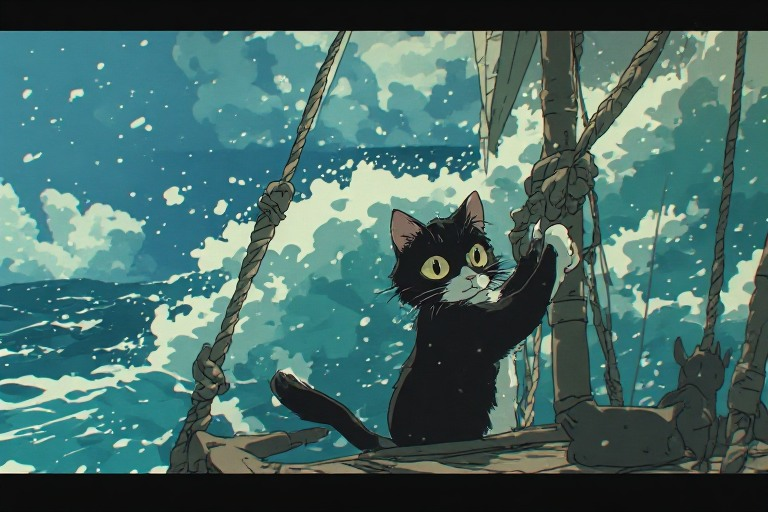
The tempestuous winds whipped across the turbulent waters of the South China Sea, threatening to capsize our vessel at any moment. The wooden hull creaked and groaned beneath our feet as the waves crashed against its weathered sides, sending spray flying high into the storm-darkened sky. It was then that the grizzled head sailor turned to me with a knowing glint in his weathered eyes and posed his philosophical inquiry: "Hang in there when the wind is rough. Are you merely clinging to survival like a desperate creature, or are you truly mastering the art of perseverance?"
His words carried weight, seasoned as they were by years of battling these unforgiving waters. Our feline companion, tasked with maintaining the delicate balance of our onboard ecosystem by dispatching unwanted rodent visitors, had retreated to the relative safety of the lower decks. Its absence was notable, particularly given the crucial role it played in our maritime community.
"Where art thou, pusa?" I called out into the howling gale, my voice barely audible above the cacophony of wind and wave. The term "pusa," derived from the ancient dialect of these waters, held a special significance among mariners of our region, representing both the animal itself and the spirit of resilience it embodied. "Pusa pusa pusa," I repeated, scanning the rain-lashed deck for any sign of our missing crew member.
The head sailor's response came steady and reassuring: "Keep hanging in there." His words weren't mere encouragement—they were a command born of experience, a reminder that survival depended on unwavering determination. I acknowledged his counsel with a firm grip on the slick railings, my knuckles white against the force of the gale.
"Pusa pusa pusa," I called again, but there was no response. The silence was oppressive, punctuated only by the rhythmic crashing of waves and the creaking of strained timbers. Then came the head sailor's observation: "He is hanging in there," his voice carrying a deeper meaning than mere literal interpretation.
"I'm aware of that, sir," I replied with measured respect, though my mind was consumed by concern for our missing companion. It was then that the head sailor began to weave a tale from the rich tapestry of maritime folklore—a story passed down through generations of South China Sea sailors, told specifically during moments of trial like ours.
These tales held particular significance in our region, where the boundary between sea and sky seemed to blur in storms like ours. They weren't merely entertainment; they served as cautionary lessons, shared during moments when nature's fury reminded us of our vulnerability. The head sailor enhanced the atmosphere by positioning his lantern beneath his chin, casting eerie shadows that danced across his face like restless spirits.
He spoke of a leviathan, a monstrous whale that defied conventional description—a creature so massive it seemed to embody the raw power of the deep itself. According to legend, it patrolled these waters with territorial ferocity, challenging any vessel that dared enter its domain. The tale claimed that even mighty warships had fallen prey to its wrath, their destruction attributed to wartime losses rather than the monster's vengeance.
An inquisitive sailor dared interrupt the narrative: "But how did you survive if this was the case?" The head sailor's expression turned stern, his patience worn thin by the interruption. He resumed his tale, explaining that his survival was purely fortuitous—that even the most hardened veterans had succumbed to the beast's fury.
The story took an unexpected turn when the bookshelf behind the sailor suddenly toppled, sending volumes and documents cascading onto the deck. The timing couldn't have been more dramatic, occurring precisely as the tale reached its climax. Younger sailors gasped in unison, their faces pale in the dim lantern light.
Then came the head sailor's triumphant cry: "Behold the great sea whale!" His voice was slurred, influenced by the forbidden red horse beer he'd smuggled aboard. It was in this moment of heightened tension that our missing pusa appeared, emerging from amidst the scattered papers near the porthole where it had been seeking refuge from the stale cabin air.
The younger sailors breathed collective sighs of relief: "Thank goodness it is just a pusa." Their reaction wasn't merely humorous—it reflected the deep-seated superstition that pervaded our maritime culture. The cat, seemingly oblivious to the drama it had caused, climbed onto the nearest sailor's lap and promptly returned to sleep.
The head sailor seized upon this moment to reinforce his earlier lesson: "The pusa hangs in there when it gets windy," he declared, his repetition of this phrase serving as more than mere observation—it was a teaching moment, one he hoped would imprint itself indelibly in our memories.
As he continued his tale, the winds howled through the damaged porthole, bringing a welcome freshness to our cramped quarters. However, this same breeze proved less welcome to our feline friend, who had previously enjoyed the view of the South China Sea through that very opening. The cat's displeasure was evident in its agitated movements, a subtle reminder that even the smallest creatures must adapt to changing circumstances.
One of the sailors couldn't help but wonder: "Could it be true? Might the great sea whale indeed be lurking beneath our hull, waiting for its moment to strike?" The question hung in the air like the storm clouds above us, heavy with uncertainty.
According to the tale, the whale's influence extended far beyond individual encounters. During periods of conflict that had scarred our region, it was said to have sunk multiple battleships simultaneously, its actions masked by the chaos of war. Over time, the creature had established a thriving dynasty, its family bonds strengthened by seasonal gatherings in the heart of the ocean.
"But how many of them are there?" another sailor pressed, seeking concrete evidence of these extraordinary claims. The head sailor's response was immediate and chilling: "No one was saved. The great whale destroyed them all. Even the pusa who stayed on board was unable to survive its wrath."
This final revelation proved too much for the assembled crew. Weary of unsubstantiated tales and denied access to the coveted red horse beer, they saw their chance when the head sailor drifted toward unconsciousness. They helped themselves to his hidden stash, even sharing some with our curious cat, who watched the proceedings with knowing eyes.
The head sailor's slumber was brief, interrupted by his own screams about the necessity of hanging in there against the great sperm whale. His warnings continued even as he drifted back into sleep, his voice carrying on the wind that whistled through the damaged porthole where our pusa had once sought refuge.
His final reference to the familiar poster of a determined cat clinging to its perch struck a chord deep within us. It wasn't merely a humorous comparison—it was a powerful metaphor for our shared experience, a reminder that survival often depends on nothing more than sheer determination to persevere. As we rode out the storm, each of us knew that we, like the pusa, must hang in there when the winds grew rough, trusting that our collective resilience would carry us through even the most turbulent of times.