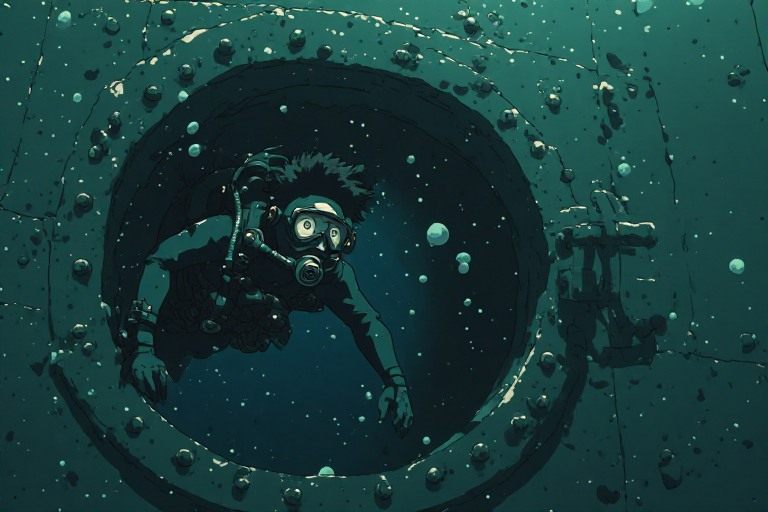
The Castilian Trench
I had recently been granted the rare and exhilarating opportunity to conduct deep-sea diving expeditions around the remote Spanish islands. It was a self-prescribed sabbatical, a much-needed window to relax my mind after the grueling process of finishing my doctorate, and it provided me with the solitary time required to contemplate my next career move.
Everyone needs such a holiday at least once in their life—a liminal space to decide precisely where they will go next. Besides the psychological necessity of the trip, it had always been a childhood desire of mine to explore the sun-drenched Spanish islands and locate lost historical treasure.
Back at my local university, my peers and professors always remarked that I possessed an uncanny, almost eerie level of intuition. Whenever the student union organized charity treasure hunts across the campus grounds, I would invariably find the hidden items. In fact, I consistently found the most eggs during the annual spring hunts—a statistical anomaly that gave everyone ample reason to jokingly believe I possessed genuine psychic abilities.
However, intuitive gifts do not pay for marine logistics. In order to afford my deep-sea diving exhibition, I spent the preceding summer working a series of demanding odd jobs to accumulate capital. My primary employment was assisting a veteran commercial pilot with his daily operational duties at a local aircraft hangar.
The university town I called home was not particularly large, but it boasted an immense student population. The local hangar served as a vital regional hub where private flights constantly shuttled back and forth to the major city centers. A massive portion of the agricultural businesses operating in the remote provinces relied heavily on this hangar for their corporate operations, which made complete sense given that industrial farms required airplanes to spray their vast crops with liquid pesticides.
Drones, Drunks, and Disruption
One quiet afternoon, while sitting inside the hangar office, the seasoned pilot opened up to me regarding the anxieties of his trade. He confessed that a wave of young university students was systematically stealing his contracts. These tech-savvy youths were using autonomous commercial drones to spray pesticides on the crops, bypassing the need for manned aviation entirely.
I asked him if he could simply obtain the modern chemical certifications to outdo them, proving his superior capability in handling hazardous materials. The pilot sighed, explaining that the idea had already occurred to him, but the students were far smarter than they appeared. They were rapidly stocking up on advanced qualifications and safety certifications, monopolizing the dangerous chemical market.
It felt like a profound shame that an exciting, romantic industry like private aviation could be disrupted overnight by a drone startup. After all, virtually anyone can learn to fly a drone with minimal training. My younger brother was a prime example; he was constantly flying his quadcopter around our town, irritating the neighborhood at all hours of the night.
On one notable Friday evening, after the local population had migrated to the pub, my brother flew his drone low over the main street just as the patrons were walking home half-drunk. He dimmed the standard navigation indicators and flashed a series of customized, ultra-bright LED lights, making the aircraft look exactly like a descending UFO.
He filmed the terrified, intoxicated patrons running for their lives as he chased them down the cobblestone alleys. While the video amassed views online, I thought the prank was in incredibly poor taste. It gave me a sudden shudder to think that tech-obsessed students just like him were now poised to dominate the agricultural sector.
Regardless of my personal opinions on automation, the money I saved from my part-time work at the hangar proved sufficient. When I finally arrived in the vibrant Spanish islands, I had enough capital to rent professional scuba gear, charter a boat, and secure an industrial underwater metal detector to scan for sunken Spanish gold.
The Submarine and the Sovereign
My chosen crew did not waste a single moment of daylight. We immediately began testing the coastal waters on the very first day of our arrival. We were exceptionally hardworking, pushing ourselves to dive down incredibly deep during the initial runs so that our bodies could get thoroughly accustomed to the intense pressure of the region.
There were ten of us in the water, navigating the shifting currents. The area was notorious for sudden, wild rip tides, but fortunately, we had all completed advanced open-water swimming lessons before embarking on the trip. During our third afternoon, I was caught in a powerful rip myself. Instead of panicking, I simply laid back, stabilized my breathing, and floated calmly until the current naturally dissipated. I felt as though the ocean itself was testing our resolve—demanding to know if we were truly worthy to uncover its deep secrets.
The following day, spurred on by my survival, I swam deeper than I ever had before. The other students in my party grew fatigued, eventually abandoning the descent to return to the sunny surface. Left entirely alone in the dim, blue abyss, I continued my search until I discovered a massive underwater mount. Perched precariously upon its jagged peak sat a rusted, silent Russian submarine.
I immediately swam behind a cluster of boulders, hiding myself to observe the vessel and determine if it was still operational. Suddenly, a powerful, concentrated beam of light pierced the gloom from the opposite direction. I squinted through my mask, spotting another diver.
At first, I thought it might be a member of my crew, but this individual was vastly different. Their movements were exceptionally fluid, indicative of elite military training, and they wore highly advanced, closed-circuit rebreather equipment far more expensive than the budget gear we had rented.
I watched in fascination as the mysterious figure swam directly toward the submarine’s main hatch.
A Linguistic Clue
As I observed the intruder, a piece of trivia from my university language courses surfaced in my mind. In the Russian language, the word for a standard interior door is дверь (pronounced dver). To an English-speaking ear, it sounds remarkably close to the word "diver." In the silent depths of the sea, the linguistic irony was palpable: I was a diver watching another diver pass through a steel dver into a sunken Russian relic.
Explosion and Extravagance
Driven by intense curiosity, I crept closer to the vessel, concealing my form just behind the open door. Through the viewport, I watched the mysterious diver swim back toward the exit, clenching a heavy, waterproof suitcase. Sensing a dangerous covert operation, I waited for him to depart before slipping inside the airlock myself.
The interior did not contain historical gold. Instead, my flashlight illuminated crates of tactical gear and a glowing digital timer wired directly to a massive payload of commercial explosives. The timer was counting down rapidly.
Panicking, I grabbed three heavy, canvas supply bags resting near the hatch and kicked away from the vessel with all my might. It was clearly a planned demolition to erase the submarine's presence. I swam toward the surface at a frantic pace, ignoring proper decompression protocols and never looking back to see if the mysterious agent was pursuing me.
I securely tied the straps of the heavy bags around my arms, digging my fins into the water. Suddenly, the oppressive silence of the deep ocean was shattered. A massive, concussive explosion ripped through the trench, the shockwave vibrating violently through the water column and striking my body like a physical blow.
That deafening vibration was the absolute last thing I could remember.
The Drone Enterprise
I woke up the following morning in the safety of our hotel room, the bright Spanish sunlight streaming through the curtains. The concussive blast had evidently knocked me unconscious, and my crew had pulled my floating body from the water.
My friends were gathered around the bed, eagerly waiting to greet me. Surprisingly, due to a strict adherence to my privacy, they hadn't even checked the contents of the canvas bags while I was asleep.
With trembling hands, we unzipped the heavy canvas. Inside lay dozens of velvet pouches filled to the brim with uncut, high-purity diamonds.
"We have to go back down," I stammered, my voice hoarse from the salt water. "There must be an entire fortune left in that trench."
However, the local sailors we chartered informed us that the area was locked down by naval authorities investigating the blast, and rumors whispered of strange, covert characters hiding out in the dense jungle interior of the island. The risk was simply too high.
Unfortunately for our treasure-hunting ambitions, the summer came to an end, forcing us to return home. However, the diamonds we successfully salvaged were more than enough to completely pay off our university tuition fees and provide the seed capital required to launch our very own agricultural pesticide business.
Instead of purchasing incredibly expensive, high-maintenance airplanes, we invested heavily in a fleet of cutting-edge industrial drones. It did hurt my conscience slightly to take business away from the local hangar pilot who had mentored me, but we quickly devised a solution. We extended a lucrative job offer to the veteran pilot, hiring him to command and coordinate our autonomous drone squadrons from the air-conditioned comfort of his own pickup truck.
He was absolutely thrilled to get involved, escape the financial stress of solo operation, and make a fantastic living. Ultimately, the partnership allowed the students to learn advanced aerodynamic principles from a seasoned professional, and our steady corporate lease helped him keep his beloved regional hangar open for future generations of pilots.