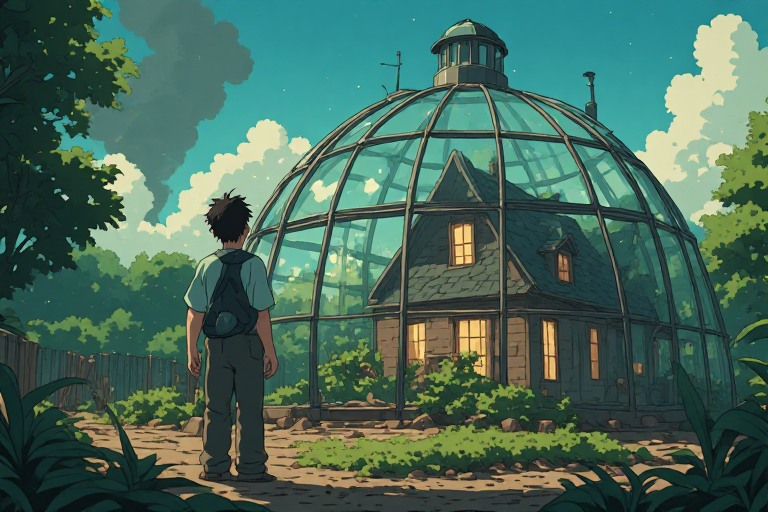
The Master of the Dom
Once upon a time, on the quiet, verdant fringes of a bustling provincial town, there resided a solitary gardener. He was a man uniquely attuned to the rhythms of the earth, thoroughly content with his modest lot in life. He asked for nothing more than the simple pleasures of horticulture and the quiet pursuit of knowledge, spending his days cultivating his plots and his evenings curating a vast personal library of rare botanical texts. He was a peaceful soul who harbored no malice, bothered no one, and wished only to coexists harmoniously with the world around him.
Yet, his peaceful existence was fundamentally altered during his late-night vigils. Surrounded by heavy leather-bound volumes on horticulture and the classic architectural principles of structural integrity, he discovered a terrifying truth hidden within the data.
Through meticulous calculation, he realized that the unchecked overpopulation of the surrounding territories was rapidly accelerating environmental collapse. It was not a matter of if, but when, the atmosphere would become entirely toxic, rendering the air unbreathable and bringing human civilization to a grinding halt. The calculations were absolute: the looming ecological apocalypse was inevitable.
According to his architectural studies, the singular means of surviving this impending atmospheric cataclysm would be to erect a colossal, hermetically sealed protective dome directly over his residence.
A Note on Language: To understand the profound irony of his shelter, one must look to the Russian language, where the word for "house" is “dom” (дом). Phonetically identical to the English word "dome" but spelled without the trailing "e," it serves as a perfect linguistic mirror: the man was forced to construct a massive dome to preserve the sanctity of his dom.
The Unheeded Prophet
Driven by a profound sense of moral duty, the gardener resolved that he could not keep this apocalyptic prophecy to himself. It was imperative that he warn his fellow townspeople so that they, too, might construct engineering marvels to shield their families.
In the crisp, early hours of the morning, he wandered from threshold to threshold, knocking on doors and urgently spreading his grim warnings. The citizens of the town, however, were entirely unimpressed by his urgent pleas. Some dismissed him with a wave of the hand, branding him a madman driven crazy by too much solitary reading. Others, irritated by his persistence, loosed their guard dogs upon him.
The village children, taking cues from their elders, chased him down the cobblestone streets, jeering and hurling sticks at his retreating form. Even the stray hounds would snarl aggressively, snapping at his ankles as he tried to speak.
It was a profoundly disappointing and deeply traumatic ordeal for a gentle horticulturist whose only crime was attempting to save his neighbors from a suffocating doom. But humanity, historically, has rarely been kind to its prophets. It was not every day that a local dirt-farmer went door-to-door proclaiming the end of days, and the town simply lacked the imagination to believe him.
Defeated but undeterred, the gardener retreated to the outskirts of town. Sitting at his wooden desk beneath the warm glow of his oil lamp, he pondered his next move. He could not force the villagers to see the invisible poison on the horizon. If they chose to perish in their ignorance, so be it; he would ensure his own survival.
The Fortress of Glass and Green
With unwavering discipline, the gardener set to work drafting the blueprints for his personal sanctuary. He would survive the apocalypse, accompanied by his carefully nurtured garden of heirloom tomatoes.
Over the subsequent weeks, he quietly amassed a massive stockpile of construction materials, structural steel, and specialized glass. Concurrently, he rationed and accumulated enough non-perishable food stocks to endure a protracted period of global toxicity.
Based on his meteorological projections, he estimated that it would require precisely 360 days of atmospheric stagnation before the natural currents of the planet could successfully scrub the air clean again. This one-year timeline meant he would have to rely heavily on the provisions he had meticulously secured from local merchants.
To prevent suffocation within the sealed structure, he relied on his botanical expertise. He designed the dome to be vast enough to act as a self-sustaining ecosystem; his lush interior plants would consume his exhaled carbon dioxide and generate a continuous supply of pure, filtered oxygen. These complex mechanical and ecological skills were the fruit of his youth, hard-earned when he was an aspiring student at the local technical college.
When the monumental structure was finally completed, it stood as a towering testament to engineering quality—yet it only amplified the ridicule of the townsfolk. He became the premier laughingstock of the valley. While a handful of onlookers were secretly awed by the sheer architectural brilliance of the massive dome, the vast majority viewed it as the ultimate monument to eccentricity.
The gardener left the overhead vents of the dome wide open, waiting patiently for the exact chronological threshold he had calculated to be the end of the world. When that fateful morning arrived, he sealed the heavy airlocks and closed the dome completely.
Initially, nothing happened. The sky remained blue, and the air seemed clear.
The villagers' mockery reached a fever pitch. They gathered outside the glass perimeter, laughing uproariously and hurling debris at the impervious walls. The gardener stood his ground with stoic dignity. He refused to internalize their taunts, remaining focused on his survival protocol. He rationed his food supplies with mathematical precision and diligently calibrated his air-quality monitors every morning.
The Poison Sunset and the Silence That Followed
Then, without warning, the world shifted. An ominous, unnatural stillness blanketed the landscape; the wind died, and a heavy silence took hold.
Moments later, a thick, surreal yellow haze crept over the horizon, engulfing the sky in what looked like a beautiful yet deeply poisonous sunset. It was, in a very literal sense, the sunset of human civilization. It was the end of humanity, unfolding just as the lone gardener had predicted.
From the safety of his vibrant green sanctuary, the gardener watched with a heavy heart as the toxic yellow fog rolled across the valley like an encroaching tidal wave. The villagers were in the middle of their mundane, daily routines when the haze descended. For a fleeting moment, confusion reigned—until the memory of the gardener's frantic warnings flashed through their collective minds.
But the yellow haze moved with terrifying velocity. Within minutes, the poisonous air infiltrated the town, swiftly suffocating the population. The local birds, possessing a sharper instinct for survival, took flight en masse, soaring high above the roiling gas clouds. They would be forced to fly continuously for days on end to outrun the disaster, but many would ultimately survive the apocalypse.
The gardener stared out through the glass, his face frozen in a mixture of shock and profound sorrow. His predictions had been flawless.
The Mnemonic Recalled: The bustling world had shrunk to a single point. Outside the glass, the town was gone; inside, there was only the dom—the house that survived because it was a dome.
The Rebirth of Paradise
The world outside fell into an absolute, tranquil silence. There were no more angry villagers to harass the gardener, no children to throw sticks, and no dogs to snap at his heels.
The gardener adapted to his solitary routine. He stayed up late into the night, comforted by the familiar pages of his books. He enjoyed his rations, ensuring they were strictly measured to last the duration. He maintained a rigorous, disciplined lifestyle, exercising regularly within the dome to keep his mind and body sharp. For dinner, he would harvest fresh, ripe tomatoes from his vines, craft a rich sauce, and sit down to a plate of spaghetti in the heart of his indoor jungle.
Because his days were filled with purposeful labor and constant maintenance, the 360-day isolation passed with astonishing speed.
When the final morning of his calculations arrived, the gardener walked over to his environmental gauges. The instruments provided a perfectly clear, toxin-free reading.
However, he did not even need the validation of technology. Looking out through the glass, he witnessed an extraordinary sight: an immense, roaring multitude of birds had returned to the valley. The sky was alive with motion, and there was not a single tree branch in sight that was not occupied by a singing bird. The collective chorus of their chirping was nearly deafening.
The gardener unlocked the heavy pressure doors and stepped outside into the morning air. What greeted him was a vision of absolute paradise. The mere absence of human industry and intervention for a single year had allowed nature to heal completely, transforming the scarred landscape into a pristine, breathless Eden.