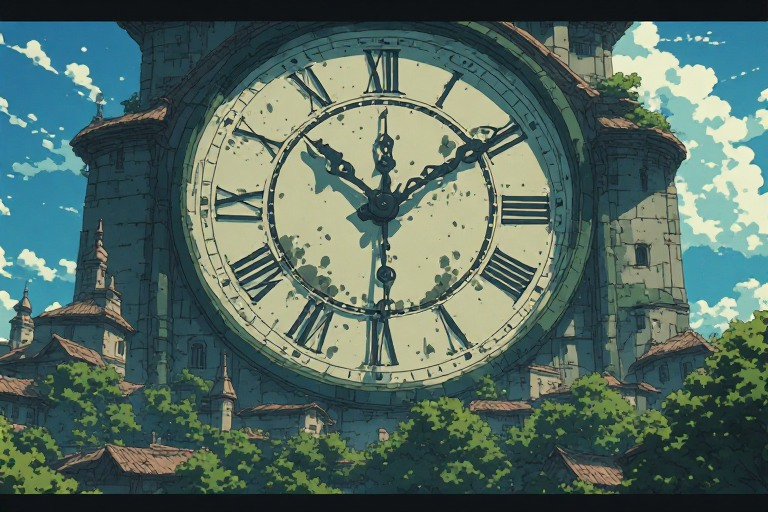
The town did not merely exist beside the clock; it was swallowed by it. Dominating the landscape for miles around, the structure was so immense that the village looked less like a settlement and more like an accidental collection of barnacles clinging to the base of a titan. Approaching the town from any direction required a long, grueling journey across open country by horse and cart. Yet, long before travelers crested the great mountain range to catch their first glimpse of the clustered rooftops, they would feel the clock. The earth hummed with it. A low, subterranean vibration rolled across the valleys, accompanied by the ceaseless, deafening clank of heavy iron gears grinding against one another, a mechanical heartbeat that dictated the rhythm of every living soul.
On a clear day, the colossal dial could be seen from over one hundred kilometers away, piercing the horizon like an industrial monolith. It served as the center of gravity for every human milestone. Infants were born to its chimes, couples were married beneath its looming shadow, and laborers began their backbreaking shifts with their eyes fixed on its towering hands. Nearly the entire municipal budget was funneled into its endless maintenance, and almost every job in the town was somehow tied to its preservation. To a stranger stepping out of a dust-covered cart for the first time, the place felt entirely surreal—a civilization built entirely to appease a machine.
Yet, the clock possessed a deeply unsettling anomaly that the townspeople had learned to live with, and eventually, to worship. Up close, the mechanics defied all logic. The minute hand and the second hand moved at a frantic, unnatural speed, constantly slipping out of sync. Day and night, the hands had to be manually readjusted so that the minute hand wouldn't aggressively outpace the second hand in a mad dash around the face. It was an erratic, living flaw in an otherwise indestructible piece of architecture.
Despite its age and the brutal extremes of the weather—baking under the merciless heat of summer and freezing beneath heavy winter snows—the clock endured. Over generations, this resilience birthed a deep, fervent superstition among the locals. They became convinced that the clock was the linchpin of existence itself; if its gears ever ground to a final halt, the apocalypse would instantly follow, swallowing the world in darkness.
This radical worldview naturally placed the village at odds with the wider world. The local church broke away from mainstream religious authorities, eventually being officially excommunicated by the main church in Moscow. Undeterred, the townspeople doubled down on their eccentric doctrines, weaving the clock into a bizarre theology where lust and greed were elevated as the fundamental forces driving the universe. They looked at the frantic, chasing hands of the clock as a physical manifestation of desire—the minute hand forever chasing the second hand in an eternal, unrequited pursuit.
The town elders went to extraordinary lengths to protect this sacred ecosystem. They hired young women, known as the "marry-less maids," to dedicate their lives entirely to the clock. Under strict vows, these women were forbidden to marry, lest their attention be divided and the clock stop working. Meanwhile, the young men of the village were conscripted into labor on the massive structure. Their primary, exhausting duty was to climb the perilous heights of the dial and physically hold back the minute hand whenever it grew too erratic in its pursuit of the seconds.
The work was grueling, especially under the biting rain or blistering sun, but the young workers took pride in it, learning the ancestral art of taming the machine. Older, weathered workers would stand at the base of the scaffolding, bellowing instructions up to the boys on the gears. They used a specific phrase passed down through generations: "Chase See."
To the locals, the phrase captured the very essence of the clock's frantic motion, describing the minute hand's desperate attempt to overtake the second. The local clergy seized upon this, preaching that this eternal chase proved that lust was the true engine of humanity—the invisible force that made the world go round.
Naturally, the religious authorities in Moscow viewed this unorthodox cult with mounting alarm. Determined to rectify the heresy, the central church dispatched a delegation of monks clad in severe black robes to bring the wayward village back into the fold. But their arrival was met with immediate, fierce hostility. When the monks rolled into town on their carriage, a mob of furious townspeople descended upon them. They dragged the carriage into the street, set it ablaze, and chased the terrified holy men out of town with burning torches, all while the giant clock ticked on overhead, bearing only a few minor soot stains from the commotion.
The local church proclaimed the survival of the town and the minor scratches on the clock as divine proof that their faith was righteous. Bolstered by this perceived miracle, the townspeople grew even more entrenched in their beliefs, viewing themselves as the holy guardians of the doomsday clock.
When the monks in black robes returned months later, they came prepared for conflict, carrying weapons to enforce their decree. But the village was ready. Perched high above the town on the dizzying heights of the clock face, the marry-less maids spotted the approaching threat from miles away. Refusing to let outsiders strip away their dignity and their way of life, they sounded the alarm, alerting the young men working below.
A fierce skirmish broke out at the base of the monument. The robed monks fought valiantly, but they were powerless against a population driven by absolute devotion and the unrelenting momentum of time. The phrase "Chase See," echoing the Russian word for "clock," became a battle cry shouted across the scaffolding. The older workers roared the words to coordinate the defense, while the younger men scrambled across the massive iron numerals, physically restraining the hyperactive hands as the chaos unfolded below.
Defeated and driven off once more, the surviving monks retreated to report the bizarre insurrection to the head bishop in Moscow. The bishop deliberated on the terminology, noting that "Chase See" was an ancient, obscure linguistic root for clockwork in certain archaic regional dialects. Yet, because the true origin of the phrase had been lost to time, the village people interpreted this linguistic ambiguity as proof that the universe held multiple, fluid truths.
To the end of their days, the villagers preached that lust was the true nature of man and that the giant clock was humanity's only bulwark against hell. They carried these beliefs into their daily lives, whispering the sacred phrase to their children and dreaming of the grand clock that loomed over their existence. No amount of ecclesiastical condemnation could pierce the armor of their isolation. Sheltered in the vast, gossip-fueled expanses of the rural frontier, their superstition grew too large to dismantle. And so the great machine remained, standing tall against the horizon—the eternal, ticking heart of a town defined entirely by the chase.