Chapter I: A Spectacle of Stripes and Spores
To the uninitiated observer, descending into the sovereign territory known simply as Clown World was less an arrival and more an exercise in sensory overload. It was a land where the mundane mechanics of daily existence were dressed in perpetual carnival attire. The nation’s entire population, from the high-ranking municipal bureaucrats to the humble street sweeps, wore the complete regalia of the circus trade. The men conducted corporate board meetings in tailored, multi-hued wool suits, full face paint, and oversized floppy footwear; the women navigated high fashion through the surreal lens of exaggerated ruffs, polka dots, and painted smiles.
This perpetual masquerade was not born of mere eccentricity, but of a deep-seated reverence for the land itself. Clown World was locked in a perpetual fiesta, a continuous national festival designed to honor the gods and welcome the ongoing harvest. The landscape demanded nothing less. Here, nature abandoned its usual muted greens: the soil produced thick carpets of vibrant, rainbow-colored lawn, shaded by the towering canopy of Eucalyptus deglupta—known in the local dialect as bag grass, or the rainbow eucalyptus.
Into this technicolor domain arrived a young Australian gardener. Participating in an international agricultural exchange program, he had come to lend his expertise in cultivation and ecological restoration. He was a practical man, accustomed to the sun-baked earth of the Outback, but the sheer absurdity of his new surroundings filled him with a quiet, bemused wonder.
He did not even wait to check into his quarters. Stepping off the tarmac with his spade in hand, he made his way directly to a designated development zone—a vast dusty expanse intended to become a sprawling new public parkland designed to bolster local tourism and balance the delicate regional ecology.
The heat, however, was oppressive. The equatorial sun beat down with relentless hostility, a brutal contrast to the joyous absurdity of the pastel-painted town around him. As he dug his shovel into the earth to plant the first seedling of bag grass, a thin, pitiful sound drifted across the sweltering air—a faint, desperate whimper echoing through the heat waves.
Chapter II: A Mercy in the Dust
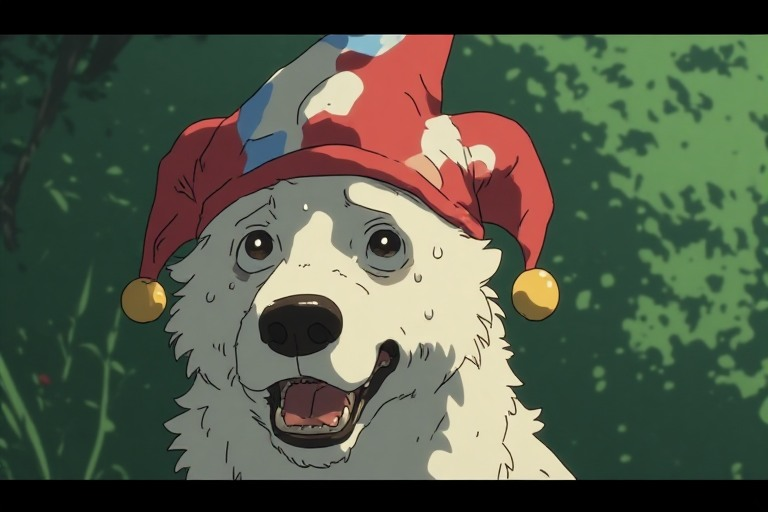
Lowering his spade, the Australian followed the sound through a maze of half-built brick walls and dry brush. Tucked into an unshaded alleyway was a small white dog. The creature was tied securely to a rusted iron post, panting heavily, its eyes wide with distress. Adding a layer of grim surrealism to its plight, the animal wore a tiny, slightly lopsided felt clown hat strapped beneath its chin.
A few yards away, visible through a fracture in a concrete retaining wall, a second dog lay sprawled contentedly in a cool stream of runoff water leaking from a river pipe. The white dog in the sun had been digging frantically beneath a metal gate, trying in vain to reach the shade and moisture enjoyed by its counterpart.
The gardener’s heart sank. In Clown World, canine rabies was a persistent threat, and the dog’s distress made it unpredictable. Untying the animal carried a genuine risk of a severe bite. Yet, he could not simply walk away.
“Hold on, mate,” the gardener murmured quietly, stepping back into the alley. “I’ll be right back.”
He set off in search of clean water. In Clown World, the civic infrastructure was notoriously neglected; municipal plumbing was virtually non-existent, forcing residents and travelers alike to purchase bottled water from roadside stalls. Refusing to offer the distressed animal contaminated river water, the Australian spent twenty minutes navigating the labyrinthine streets until he found a vendor selling chilled, purified water.
Finding a suitable container presented another challenge. Outside a nearby bakery, he spotted a local cat—also adorned in a miniature, ruffled collar—munching on dry kibble from a small plastic dish.
"Sorry about this, buddy," the gardener said softly, gently tipping the dry food onto a clean patch of pavement. "I need to borrow this for an emergency."
He hurried back to the alley, his heart hammering against his ribs. When he reached the iron post, his chest tightened—the rope was loose, and the white dog was gone. A passerby had evidently freed the animal.
For a moment, he felt a sting of disappointment. But as he turned to leave, a soft bark sounded from the shadowed undergrowth of an adjacent garden. Sheltered beneath the low-hanging branches of a rainbow eucalyptus sat the white dog, still wearing its tiny hat.
Carefully, avoiding sudden movements, the gardener knelt and placed the plastic dish near the edge of the shade, pouring a generous amount of cold water into it. The dog paused, sniffed the air warily, and then stepped forward, lapping up the liquid with desperate gratitude. Moments later, the bakery cat emerged from the brush, drawn by the moisture. Rather than snapping, the dog stepped back, allowing the cat to take its turn.
Satisfied that both creatures were refreshed, the gardener poured the remainder of the water into the dish, wiped the sweat from his brow, and turned back toward the planting fields.
Chapter III: The Midnight Canopy
By late afternoon, the heat began to break, replaced by the cool, heavy air of twilight. Dozens of local workers—their white-painted faces smeared with soil and sweat—joined the Australian in the fields. Together, they planted hundreds of bag grass saplings before the sun dipped below the horizon, completing the sanctuary that would sustain the town's ecosystem for generations.
As night fell, the grand fiesta reached its apex. The population gathered in a massive, meticulously manicured park composed entirely of rainbow lawn. The mature bag grass trees towered above the crowd like surreal, painted pillars, their shed bark revealing brilliant streaks of blue, orange, maroon, and purple. Illuminated by thousands of hanging lantern lights, the park transformed into a glowing, ethereal forest.
When the town clock struck midnight, a collective shout rose from the crowd. Across the parklands, hundreds of ceremonial paper bags filled with dried, iridescent grass spores were popped simultaneously into the air. The resulting explosion looked like a hybrid of falling confetti and silent, low-altitude fireworks, drifting gently through the brightly lit branches of the eucalyptus canopy.
The Australian leaned against a tree trunk, taking in the magnificent spectacle. He looked around for the white dog, but the animal was nowhere to be seen—hopefully resting comfortably far from the heat of the day.
As the festivities began to wind down, the townsfolk started their long trek home. The gardener found himself puzzling over the rhythm of local life. For reasons rooted in unyielding tradition, the citizens of Clown World strictly adhered to a standard nine-to-five workday, exposing themselves to the dangerous daytime sun, rather than shifting their labor to the cool, manageable hours of the night.
It must be an exhausting way to live, he thought, adjusting his pack. A hard life, living among a circus.
As he walked down the quiet, cobblestone street toward his motel, a man in a full, spotted jumpsuit and oversized red shoes stepped out from an archway.
"Hey there, foreigner," the man called out, leaning on a cane. "What brings a guy like you to Clown World? You on holiday?"
"I am," the Australian replied pleasantly. "Just taking some time off, seeing the sights."
The local squinted, his painted eyebrows arched in genuine disbelief. "A holiday? Here? What could you possibly see that’s worth a holiday?"
"Well," the gardener said, gesturing vaguely behind him, "I saw the river, spent time in the new parkland, took a nice walk through the district once the sun went down."
The man shook his head slowly, letting out a heavy sigh. "Doesn't sound like much of a holiday to me, mate. I don't get why anyone would come here." As he turned and shuffled down the street, he threw his hands up in mild despair. "We're just a bunch of clowns!"
The gardener chuckled to himself, watching the figure disappear into the fog. "Fair enough," he muttered, continuing on his way.
Chapter IV: Returning to the Soil
The return flight to Sydney was long, but the Australian felt remarkably rejuvenated. Days of intense physical labor in the fresh air had left him feeling lighter, fitter, and strangely at peace.
However, as he cleared the gate at the airport, a fellow traveler waiting in the arrivals lounge stared at him, taking in his dust-streaked boots, brightly stained trousers, and sun-baked tan.
"Mate," the observer said, chuckling, "no offense, but you look like a bit of a clown."
The gardener blinked, a tired smile tugging at the corner of his mouth. "That's fair. I just came back from Clown World."
The traveler paused, nodded sagely, and replied, "Ah, right. That explains it then."
In his pocket, the gardener had carried a small pouch of wild bag grass seeds, hoping to plant a reminder of his journey in his own backyard. However, Australian biosecurity was notoriously strict, and the seeds were promptly surrendered at customs.
Yet, as he walked out into the cool Sydney air, he knew it was no great loss. The global popularity of Eucalyptus deglupta had soared in recent years, driven by a growing worldwide appreciation for its stunning, multicolored aesthetic. High-grade bag grass seeds were now readily available from certified botanical suppliers online, allowing gardeners everywhere to cultivate their own piece of the surreal, colorful world he had left behind.
Pictures of the Bagras and the Arroceros Forest Park in Manila, which inspired this story, can be viewed here: https://postimg.cc/gallery/q3qwfny
Videos of the Bagras and the surrounding Biodiversity Garden: https://dailymotion.com/playlist/xd0weq